Liberate your musical spirit.
Learn the surprisingly simple musical game that lets you improvise, play with other musicians, and sound like yourself on the harp …
… Even if you have never improvised before.
What if this felt completely different?
What if your harp felt like a place to TRULY PLAY?
What if you could sit down without sheet music, begin with one simple pattern, and discover what happens next?
This is what people love about the Blues, and now you can do it on the harp.
Play a Blues tune in any musical key that you like.
Make up melodies instead of reproducing them.
Join friends without needing a written arrangement.
Use the same form to celebrate, meditate—or simply have fun.
Most harpists when they’re learning start with a “simple tune” and then graduate to more and more complex tunes.
What’s fundamentally different about the blues is that it’s a simple form that is infinielty expandable. You don’t learn it and then play it, you learn it while playing it. It expands you.
The secret is not more talent
Blues is a musical game.
You don’t begin by memorizing a stack of pieces. You learn one clear, flexible form—a framework simple enough to grasp quickly and rich enough to explore for a lifetime.
Once you know how the game is played, you can stop asking “What am I supposed to play?” and begin asking “How much fun do I want to have?”
Hear it from Deborah
See how this self-paced course works.
What changes when you learn the game
The more you play the “Blues,” the more you become a functional musician.
Improvise
Create melodies without needing every note written down.
Play with others
Understand the musical roles that let people sit down and play together.
Develop style
Bend notes, shape phrases and make the music sound like you.
Expand one idea
Turn one basic form into variations, arrangements and original pieces.
Play meditatively or swing it
Learn to adapt the style based on the situation
Open the door to Jazz
Build the foundations of bass line, harmony, melody and improvisation.
THE COURSE
From your first simple Blues to music that is
unmistakably yours.
1. Learn the form.
Play the foundational 12-bar Blues pattern and understand where you are in the music.
2. Build the bass.
Create a dependable left-hand foundation that keeps the music moving.
3. Add chords and melody.
Use clear choices instead of guessing what belongs.
4. Begin to improvise.
Play with notes, rhythm, repetition, space and character.
5. Play with others.
Learn the roles that make a Blues jam work—even with musicians you have never met.
6. Make it your own.
Use the form for performance, therapeutic playing, arrangement and original music.
The Result
This is what “making it your own” looks like
These students all began with the same Blues structure. None of them ended in the same place.
An advanced classical player stops worrying about wrong notes.
“The freedom was that I didn’t have to worry about ‘right or wrong.’ That is really liberating for a classical harpist like me.”
Nicole Müller
A harpist changes how people perceive the harp—and plays with a friend.
“It was much more fun to go through the process of creating something with another person than on my own, tearing my hair out!”
Jade Barnaby
A student uses the Blues to create an apology.
“DHC’s constant encouragement to each of us to appreciate what we can do at the level we are currently at—and to use our limitations to spur creativity and uniqueness instead of fretting over them.”
Harriet McKenna
Connection, not perfection.
This is where musical freedom begins.
Everything you need
Blues Harp-Style includes:
The complete six-module course
- Step-by-step video instruction
- Play-along audio files
- Downloadable PDFs and MP3s
- Optional practice and homework
- Access to course materials for one year
A course designed for actual use
- Learn in small, playable steps
- Return to lessons as often as needed
- Self-paced to fit your schedule
- Apply the Blues to your own musical goals
Join Blues Harp-Style
This Self-Paced Class Starts Whenever YOU Start
Fully Pre-Recorded, 24/7 access to fit your timeline

One payment of
$597
Pay in full
Credit card or PayPal • Course access for one year

3 payments of
$209
Scroll down in order form to “Payment Plans”
Credit card or PayPal • Course access for one year
From harpists who took the leap
Why Harpists Love Playing the Blues
“I love the freedom of this style of playing. I really get into the rhythm and feel part of the music in a way I haven’t with other music. Also, I have always been afraid of mistakes, and I have never thought I could improvise. Now I know I can. This all gives me confidence as a musician.”
Anita Jessen
“Not only have I found that I can play a blues solo … but I am so surprised that just being able to let go of wanting to be perfect and just be myself just allows creativity to flow … I’ll be experimenting more with this!”
Keith Burton
“I discovered that the groove is more important than the notes; all the notes in the pentatonic scale are “safe;” the riffs are ideas I can use & expand on.”
Midyne Spear
“It felt like a genre that was for the more experienced musicians who knew music already … It was fun, but exciting, and eye-opening that blues wasn’t just for the greats, but also a beginner like me.”
Crystal Sayers
“My family asked me to keep playing because they were enjoying it so much … I thought I needed a story, but in the end I didn’t; it was already in me.”
Laramay Thorne
“Once I know the key … I can play with anyone playing the Blues.”
Mary Anderson
“I learned that even a very few notes can be considered a riff and that a riff can take you lots of places if you let it. This will enhance my improvisation dramatically.”
Cathy Lawley
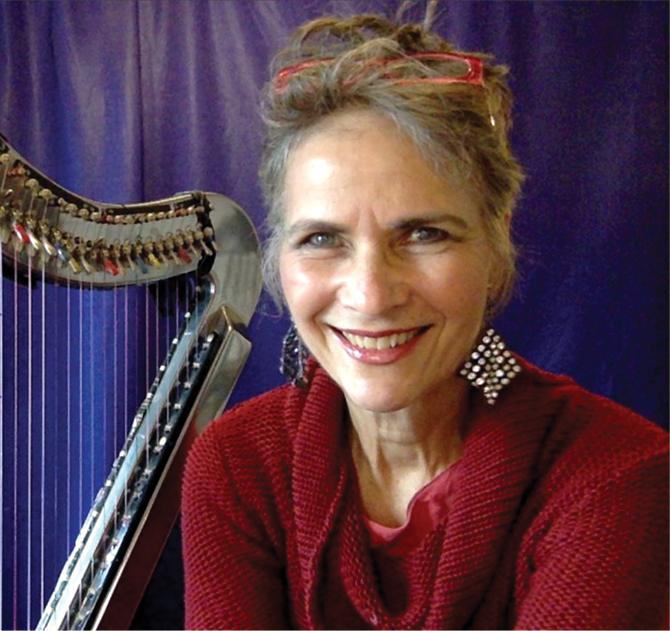
Your creative coach
I’m Deborah Henson-Conant.
I love playing the blues because it lets me use a set of skills over and over again in different ways to create a different experience. Sometimes it’s upbeat and bouncy, sometimes it’s meditative, and yet I’m using the same skills.
That gives me a sense of freedom and makes me feel that each time I play the blues I’m expanding and being more and more expressive. This is one of the foundational reasons that people love playing the blues, because it’s simple and infinitely expressive.
One of the other reasons why I love teaching it to harpists is because it’s so fun to play the blues and hear people say, “I didn’t know you could do that on a harp.”
Before you decide
You may be wondering…
Do I need to know how to improvise?
No. Learning to improvise is the point of the course. You begin with a simple structure and clear choices.
Do I need a strong background in theory?
No. The course teaches the musical form functionally—through hearing, playing and understanding what each part does.
Is this only for Jazz harpists?
No. Students have used the Blues for classical development, therapeutic playing, composition, accompaniment, ensemble playing and personal creative exploration.
If you want to see videos of the kinds of blues harpists of all technical levels have created in this class, click here.
Would the Academy be a better choice?
The year-long Hip Harp Academy includes this course along with dozens of other classes, live coaching, and a powerful, supportive community. Learn more and join.
What if I am already a Hip Harp Academy member?
Full-Level Academy members are already registered for Blues Harp-Style and receive the bonuses announced for the program. They should not purchase it again.
Think about it
You could still be waiting for someone to tell you what note comes next.
Or you could sit down at your harp, begin with one simple pattern—and discover what you have to say.
Blues Harp-Style is not really about learning one more kind of music.
It is about learning how to play.