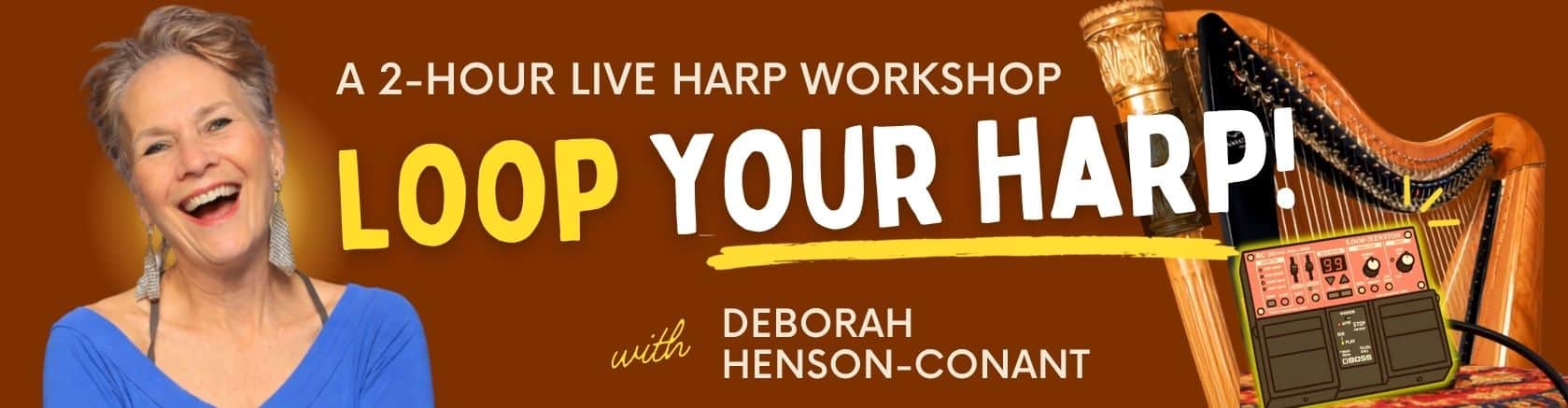
One of the most useful pieces of tech I use to go with my harp playing is a looper (or looper pedal). It is an electronic device that creates instant recordings of a musical performance and plays those recordings back in real-time. It’s like having your own harp accompaniment – that you create yourself.
It can be as simple as recording a short chord progression of arpeggios. BUT it can also expand — you can keep adding more layers to that loop to create a multi-layer harp orchestra. It all depends on whether you’re using it to play in a therapeutic situation, or to learn improv, or for practice, or in performance – and you can loop in ANY style of music YOU like to play.
This Sunday at 2:30 pm EDT, I’ll help you cut through the complexity of the tech. I’ll show you how to use it in simple and beautiful ways, and you’ll see that it’s a tool that can give every harpist a new kind of freedom — whether you’re playing Pachelbel, folk songs or jazz.
Wondering if you want to get your own looper?
Hip Harp Academy members explore their creativity through weekly homework and, at the conclusion of each quarter, through the submission of their “Final-Beginning Projects.”
Watch some of the Hip Harp Academy members explore their looper pedals in different ways.
Cherrie (playing a traditional Irish waltz “Arran Boat Song”)
Cherrie used a looper pedal to play a Celtic melody, “Arran Boat Song.” She explained, “My family comes from Scotland, and this tune is my husband’s favorite Celtic tune.”
In one of the classes in the Academy, she got intrigued and started researching and experimenting on how to use a looper pedal.
Cherri said, “I felt I had more freedom to play while using the looper pedal, as I didn’t need to play everything at once. When I had recorded each track, I could forget about it and add other tracks on top until there was a full sound.”
How did Cherrie use the looper in her playing?
She started with a drum rhythm and added four tracks from different parts of the harp to enhance the melody.
[See the bottom-left insert in the video how Cherrie used her looper pedal]
Cherrie (playing my composition “Cosita Latina”)
Cherrie did a beautiful version of my composition “Cosita Latina.” Using the looper pedal, she also added a Latin drum rhythm in the middle part of the piece.
To be able to play this, Cherrie needed to outline what sections she wanted to develop. Because I have already published “Cosita Latina”, the melody had been written out, so it gave her the feel of the tune to come up with something for the other sections.
[The loop part starts around 01:23 in the video]
Cherrie (playing a classic piece “Pachelbel’s Canon”)
Pachelbel’s Canon (an accompanied canon by German Baroque composer Johann Pachelbel 1653–1706) is a famous canon which combines a simple, endlessly looping eight-note bass line that is widely used in modern pop music.
Cherrie said, “I used my looper and experimented with different variations of Pachelbel’s Canon in C. In the middle I stopped the looper, modulated to A harmonic minor, played a variation, came back to C, and started the looper again.”
She tested out various chords to use, and she also used different techniques as she experimented with her looper pedal. She’s also glad that she figured out how to balance the volume between her harp, the recorded loop, and the rhythm track.
[Cherrie started using the looper at the very beginning of the video]
Sally (playing my composition “Cosita Latina”)
“Cosita Latina” is one of the tracks on my album “Artist’s Proof: Phase 2.”
Sally played this piece with a looper pedal using some of the suggested chords I gave. She played it on an electric harp, which sounded really great.
[The loop part starts around 05:00 in the video]
Sally (playing a birthday greeting for her sister Eve)
Sally recently shared a video of her lovely birthday greeting for her sister Eve, using the blues bassline loop from my song “Dogs of Somerville.”
A little backstory about my song “Dogs of Somerville” (also called ‘Round the Corner’) is the opening track of my album – with the same title ‘Round the Corner’ – played as an instrumental jazz standard-style with harp, bass & drums.
Watch how Sally used her looper pedal to record the first layer of the loop at the beginning of the video.
[The loop playback starts at around 00:28]
Midyne (playing an original song she wrote)
Midyne played the verse & chorus of her original song she wrote a while back.
She did something totally different using the looper pedal — she actually loaded a pre-recorded backing-track for her song into her looper.
Midyne explained, “I used a looper to record a guitar and rhythm track. I then jammed on the harp while singing. I’m also playing standing up, which I haven’t done before with this acoustic harp. I’m having fun getting to know the looper and reacquainting myself with playing standing up.”
For her, the looper is opening a whole new realm of possibilities. With the guitar playing the rhythm part, she’s doing very different things on the harp than usual if she was just playing the harp alone.
Harpists Who Dare
Ready to liberate yourself from the notes on the page?

Join for Freebies, Stories & News
Join to get weekly-ish emails with stories, videos & events like concerts & classes
Yay! You should get my next newsletter within the next 7-10 days. I'm so happy we'll be in touch!
I won't ever share your email address with others - and you can unsubscribe anytime, tho most people say they really enjoy these weeklish emails.