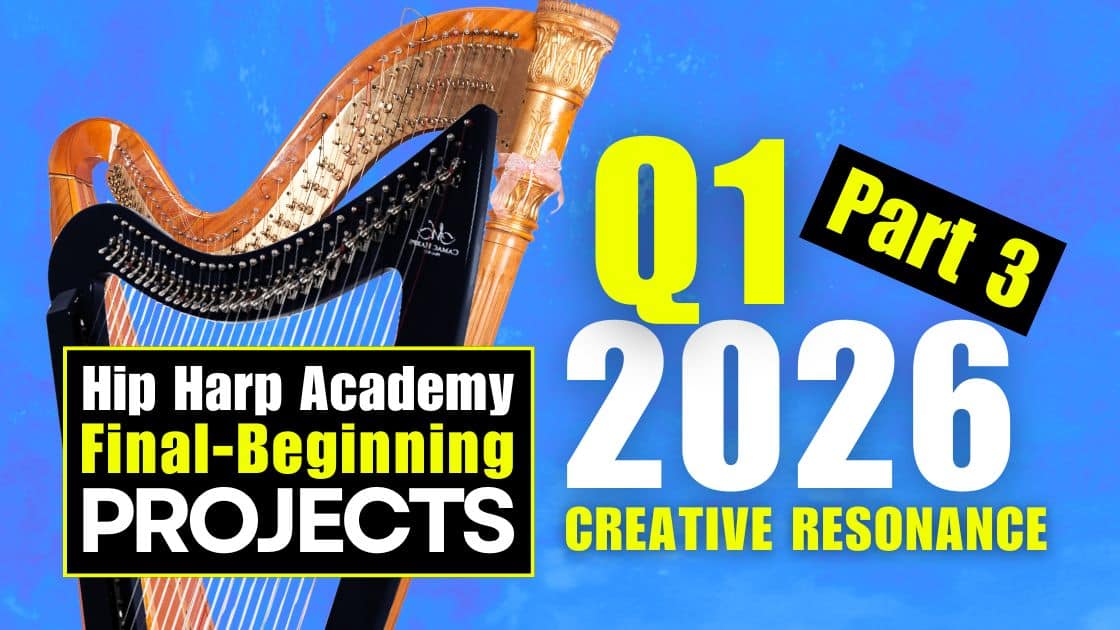
Why “Final-Beginning” Projects?
We call them “Final-Beginning” because if we worried about making them FINAL, we’d never share. Instead, we celebrate each completion as a new beginning that opens doors, builds confidence, and launches the next level of creative expression, always celebrating:
- Creativity: Each project is a commitment to authenticity in creative self-expression — honor the willingness to create and share.
- Individual Expression: Notice how each creative project is completely unique, despite all students taking the same program.
- The Process – Creative Tools in Action: Read each member’s account – in the toggle below in their video – of what tools, skills and experiences in the Academy they used to complete this project. Experience how the PROCESS – not just the presentation – can inspire and inform YOUR creativity.
Ready to unlock YOUR Creative Adventure?
And now – drumroll please! Get ready to be inspired by:
PART THREE of the 2026 Q1 “Creative Resonance” Final-Beginning Projects
CS:
I am still surprised that a song can show up like this and be as meaningful to my heart as this one is. Never had that with anything that came from me.
CS's insights about this project
Describe your final project so I know exactly what you’re sending me.
This song showed up during the first evening while walking along the beach that is in the video. It was kind of finished already, didn’t feel like something I created, was somehow just there. And it kept coming up every time I walked along this beach, so at the 3 evening I decided to write it down and figure out how to play it in the harp.
What principles from this course or from chats did you use to develop, perform, and record this project – and how did they play a part in your process?
Actually it feels like I didn’t do anything consciously, it was more an opening up, but I then decided to add an improv section.
Give a short description of what it took for you to be able to play what you did – both logistically and emotionally.
I was on holiday, so only had the eharp with me and nothing to record with. Only came home last night, so only had this evening to get it recorded and uploaded
What freedoms and blocks within yourself did you connect with (or struggle with) in the process?
The main block was that it showed up as a song and only playing the melody didn’t feel right. So I had to sing although I feel that’s not something I can do. But somehow sharing it felt more important than doing it perfectly.
What challenges did you meet while connecting with your own freedom of expression in this project?
First I tried to make a video of me playing and singing it, but that felt like one step too much, so I figured out this what feels like a compromise, using pictures of where it showed up for me.
What other parts of your life were impacted by what you learned in this class, and how?
Doing something at all is more important than doing it correctly
What were your personal “Ahas”?
I am still surprised that a song can show up like this and be as meaningful to my heart as this one is. Never had that with anything that came from me.
Is there anything else you want people to know when they watch your video?
Don’t expect it to be perfect. I am too tired, had too little time and having to use my voice is a major challenge to me
Julia Cunningham:
One of my biggest “aha” moments was recognizing how strongly gratitude influences creativity for me. When I approach music from a place of appreciation rather than pressure, the music and video creation flows much more naturally.
Julia's insights about this project
Describe your final project so I know exactly what you’re sending me.
My final beginning project is a music video for my harp piece “Reflections.” It pairs harp music with video imagery of flowing water and forest scenes to create a meditative, calming experience. The project was inspired by gratitude for the gift of life and the love and encouragement of my mum, and it invites viewers to pause, reflect, and appreciate the simple beauty around them.
Describe your written materials – if there’s anything in particular you want to say about it to help people know what they’re looking at, add that here.
I just wanted to add that I haven’t released this video publicly yet so I’d prefer that it’s just shared in the Academy for now and not shared publicly just yet. Thanks!
What principles from this course or from chats did you use to develop, perform, and record this project – and how did they play a part in your process?
One of the most valuable principles I learned through the Academy was trusting my own creative voice and vision. “Reflections” was composed earlier, but creating the video gave me the opportunity to revisit it with fresh ears and bring it to life visually.
Give a short description of what it took for you to be able to play what you did – both logistically and emotionally.
Logistically, this project involved revisiting a piece I had composed earlier and creating a visual setting to match its spirit by selecting and editing imagery of flowing water and forest scenes.
Emotionally, it came from a place of reflection and gratitude following significant life events, including receiving the gift of a kidney transplant just 4 months ago, and losing my beloved mum on January 17, 2026. Revisiting the music allowed me to share it from a place of quiet contemplation and appreciation for life.
What freedoms and blocks within yourself did you connect with (or struggle with) in the process?
I was reminded that quietness and space can carry great emotional depth.
What challenges did you meet while connecting with your own freedom of expression in this project?
One challenge was finding visual imagery that truly matched the feeling and pacing of the music. Since the piece had been composed and recorded earlier, I wanted the video to honor the spirit of the original performance rather than distract from it. I spent time selecting flowing water and forest scenes that felt naturally aligned with the music, allowing the visuals to become a gentle extension of the harp.
Another challenge was trusting simplicity: letting the calm and spaciousness of the music guide the imagery without feeling the need to add too much.
What other parts of your life were impacted by what you learned in this class, and how?
The lessons in listening and presence have influenced many areas of my life. I find myself slowing down more, paying closer attention to small details, and appreciating the quiet beauty in everyday moments. The class also reinforced the importance of trusting one’s own voice and creative instincts, which has encouraged me to continue creating and sharing music.
What were your personal “Ahas”?
One of my biggest “aha” moments was recognizing how strongly gratitude influences creativity for me. When I approach music from a place of appreciation rather than pressure, the music and video creation flows much more naturally.
Is there anything else you want people to know when they watch your video?
Reflections” is meant to be a quiet invitation to pause and breathe. The flowing water and forest imagery mirror the feeling of the music – a sense of calm, gratitude, and connection to life’s simple beauty. I hope it offers viewers a moment to reflect and appreciate the gifts that surround them.
Lynne Reardon:
In the Academy, I became more familiar with using modes, so I experimented with them while working on this project. Also in the Academy, I gained more courage to do storytelling because of receiving encouragement during the chats.
Lynne's insights about this project
Describe your final project so I know exactly what you’re sending me.
The Tale of the Dagda’s Harp (storytelling with music)
What principles from this course or from chats did you use to develop, perform, and record this project – and how did they play a part in your process?
In the Academy, I became more familiar with using modes, so experimented with them while working on this project. Also in the Academy, gained more courage to do storytelling because of receiving encouragement during the chats.
Give a short description of what it took for you to be able to play what you did – both logistically and emotionally.
I needed to watch and listen to as many versions of this story as I could find, each one different, and then create my own version while trying to stay true to the mythology. I also experimented with many bits of music to find ones that felt good enough to convey the various feelings in the story. I will continue to tell this story, and the music I use will probably keep evolving.
What freedoms and blocks within yourself did you connect with (or struggle with) in the process?
I found the freedom to let go of perfection and let go of the need to play something complex to convey a desired feeling.
What challenges did you meet while connecting with your own freedom of expression in this project?
I had to re-record because of a challenge getting a well-focused video picture. And then had to re-record because the video camera battery died in the middle of the story. In researching this story, I encountered different pronunciations for some of the names (somewhat frustrating) and had to decide which to use. Another challenge was trying to memorize both the story and music; that will take me more time and patience.
What other parts of your life were impacted by what you learned in this class, and how?
Because of receiving encouragement, I can now incorporate storytelling into some of my gigs.
What were your personal “Ahas”?
It was an “Aha” to realize that I am capable of telling a story, even as a novice storyteller.
Is there anything else you want people to know when they watch your video?
Because of the challenges above, I was delayed in uploading my video to YouTube; then YouTube surprisingly needed more than two hours (!) to upload this short 11-minute video. Frustrating! So I missed the midnight deadline. For this I apologize. In the future, I will allow much more time for uploads.
Harpists Who Dare
Ready to liberate yourself from the notes on the page?
Laure Petit:
Music learns to us to listen to the others. I am improving my way of listening the others in all contexts of life. And I export to my teaching practice : connection is not perfection/ be satisfied with work in progress, step by step.
This is a commentary on the video that gives the essence of my work as an artist.
Laure's insights about this project
Describe your final project so I know exactly what you’re sending me.
In this video, I’ve brought together the various aspects of my creative work on the harp, drawing from the production *Daphné*, which stems from my work as a storyteller and musician with *L’Odyssée*: a theatrical production with young people and street poetry in the tradition of the troubadours.
Attach your homework in PDF or JPEG format here:
Describe your written materials – if there’s anything in particular you want to say about it to help people know what they’re looking at, add that here.
It’s a commentary of the video which gives the essence of my work as an artist.
What principles from this course or from chats did you use to develop, perform, and record this project – and how did they play a part in your process?
The spirit of the Teaching of Deborah : “structure is Freedom”, “Grounded expansion”. Here it’s like I show you the expansion of Daphné. To tell it a 2″00 videos and only 2 pages, is a good effort of condensation.
Strings of Passions was very important to put words on : if the muse you are looking for is you.
Give a short description of what it took for you to be able to play what you did – both logistically and emotionally.
To open myself to other peoples to work with theater and to communicate towards the other.
I do my work and at the sametimeI never lose sight of my role as a mother.
It’s important to me. I’m an artist and a mother. And the two are connected.
What freedoms and blocks within yourself did you connect with (or struggle with) in the process?
I discovered that now I can jam with other musicians with great pleasure.
I am beginning to learn modal improve and modulation from tune to tune.
I am struggling with administrative way to become artist and earn money
What challenges did you meet while connecting with your own freedom of expression in this project?
I’ve made the harp and my son my top priorities. Right now, I’m surrounded by friends, but I don’t have a partner. To be continued, because I’d like to walk alongside someone.
What other parts of your life were impacted by what you learned in this class, and how?
Music learns to us to listen to the others. I am improving my way of listening the others in all contexts of life. And I export to my teaching practice : connection is not perfection/ be satisfied with work in progress, step by step.
What were your personal “Ahas”?
It’s ok!
I am satisfied!
Are you OK with me sharing your final project & answers to the 6 questions on my blog (or just sharing your answers to the 6 questions if you didn’t submit a final-beginning project)?
Yes – and you’re welcome to use my full name
Are you OK with me sharing your final project in the Monday CHATS and if so which Chat will you be attending?
Yes – and I’ll be attending the Monday MORNING Chat
Fern Nelson:
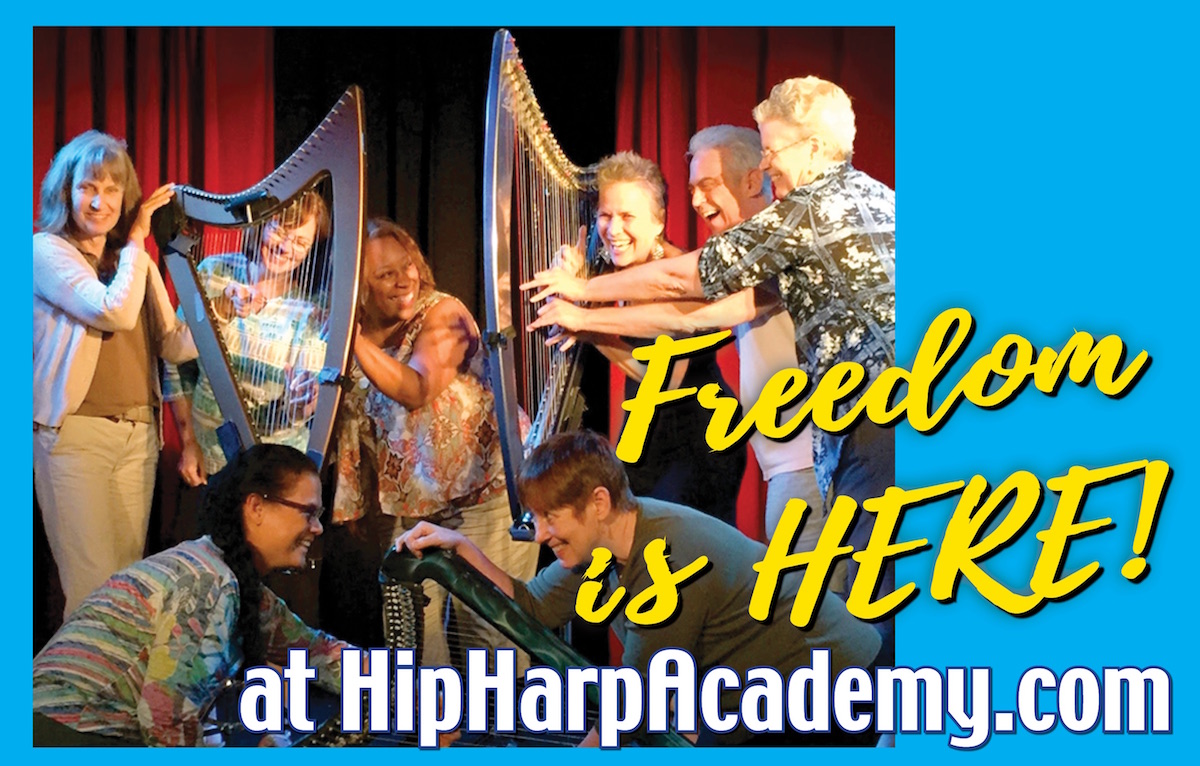
This is my first ever playing with other harpists, other than in a class/workshop structure. There were 2 harps and 3 harpists, so we rotated.
Fern's insights about this project
Describe your final project so I know exactly what you’re sending me.
This is my first ever playing with other harpists other than in a class/workshop structure. There were 2 harps and 3 harpists so we rotated.
What principles from this course or from chats did you use to develop, perform, and record this project – and how did they play a part in your process?
I get courage from the Academy members to continue to strive (or struggle) with not feeling competent.
Give a short description of what it took for you to be able to play what you did – both logistically and emotionally.
Logistically, the park was 30 miles from my house so I fussed at myself the whole time driving there. Once I saw how perfect the park was for us, and gathered with the girls, I was so happy that I had come.
What freedoms and blocks within yourself did you connect with (or struggle with) in the process?
I was a bit nervous, because one of the women does gigs, so she is accomplished in my mind. The other woman I met at the “Terrible Orchestra” on Coronado and she is a beginner but has memorized a few tunes so she seemed accomplished too.
What challenges did you meet while connecting with your own freedom of expression in this project?
I have still been trying to keep up with snippets and most of the weekly sessions and additions (like Modulation and Snippets) and not practicing any real songs to play, or even snippet with extensions made into a playable piece.
What other parts of your life were impacted by what you learned in this class, and how?
I’ve been travelling and ill, and I missed the harp and my Academy friends
What were your personal “Ahas”?
Aha, I can get back to playing songs or at least 3 minute snippet/melodies so that I actually have something to play with my Harp in the Park friends.
Is there anything else you want people to know when they watch your video?
I notice my thumbs were not up, need to work on that, noticed that I turned toward the other harpist and started listening to add notes that went along with what she was playing.
Anna Dina Green:
My work now lives in the space between discipline and wildness, voice and string, tradition and invention. It was Deborah’s unbridled joy of playing, her vivacity and unyielding belief in the latent creativity in all of us, that propelled me forwards to start creating my own unique sounds and I cannot be more thankful to both of my teachers for unlocking this new world of creative expression in me.
Anna's insights about this project
Describe your final project so I know exactly what you’re sending me.
A produced track called Waterfall composed via improvisation and adding a layer of improvised cello then mixed and arranged in Logic with a great backing track by my wonderful husband Ed.
Tell us a little bit about who you are, your harp journey, and why originally came to the Academy.
I am a London-born, half Irish, half Egyptian harpist whose path to the instrument has been anything but direct. Music was always close — piano came easily, violin less so — but the harp held a kind of mythic pull that I couldn’t reach until my twenties, when I bought a fragile £100 instrument that refused to stay in tune and slowly fell silent as life took over.
It was my first pregnancy that called me back. With a 22-string healing harp strapped to my body, I wandered the garden playing to my unborn child, relearning through instinct, exploration, and a well-thumbed folk harp guide.
A turning point came in 2024 when I began studying with Tom Moth (harpist for Florence and the Machine for nearly 20 years), opening the door to electrified harp, both his own original work and the expansive worlds of Alan Stivell, Andreas Vollenweider Caitrin Finch and Mary Lattimore. The fusion of voice and sound, inspired by artists like Bobby McFerrin, ignited something deeper — a sense of musical possibility without edges.
Though I trained rigorously, working through grades, scales, and technique, and found this grounding and important for my confidence in playing, it was improvisation that called me forward. Discovering DHC’s songs – Baroque Flamenco and 996, blew my mind and unlocked a language I recognised instantly: structured freedom. After years immersed in vocal improvisation, I finally brought that same courage to the harp and signed up for the Vision to Action course at the start of 2026. Now playing on a 34 string Dusty Strings, the direct outcome was creating a produced track called Waterfall – something totally new to me and wouldn’t have been possible without my husband Ed Green’s skills in Logic Pro and arrangement knowledge. His daughter, the very talented cellist Freya Green responded to what I had written with her own improvised response on the cello and the track was born.
With a loop pedal gifted by my husband and a leap into empowering world that DHC creates everything converged — a way of creating that is immediate, alive, and unbound.
My work now lives in the space between discipline and wildness, voice and string, tradition and invention. It was Deborah’s unbridled joy of playing, her vivacity and unyielding belief in the latent creativity in all of us, that propelled me forwards to start creating my own unique sounds and I cannot be more thankful to both of my teachers for unlocking this new world of creative expression in me.
What’s different for you now? What has changed since being in the Academy and anything particular that changed in the last quarter?
This process has allowed a collaboration to form between my step daughter, Freya, myself and my teacher Tom Moth who is producing the next 3 tracks that have sprung forth since Waterfall was released.
Also, obviously I couldn’t go forwards without joining the Academy fully to get access to more of these amazing courses – both self paced and live, which I look forward to delving into over teh next 12 months.
What principles from this quarter have you used in your life, your playing, and/or the development of this project – and how did they play a part in your process?
The structures – chord progressions if you will, have opened up playing in a new way – off the page baby!
Give a short description of what it took for you to be able to play what you did – whether you recorded and shared it or not – both logistically and emotionally.
I had to arrange childcare, set up a space and time just for this work where I could be undisturbed and my husband helped greatly with all of that.
What freedom and joy within yourself did you connect with in the process?
The joy of playing and creating in my own unique way that Improvisation allows felt like coming home to a part of myself I’d forgotten existed.
What challenges and blocks to your own freedom of expression did you experience in this class and/or project?
I realised I had placed the harp on a pedestal — something delicate, formal, and confined to quiet rooms, big dresses, and proper classical pieces. That belief created a subtle but powerful block, making me feel like I had to play a certain way to be “allowed” to play at all. It kept me careful, controlled, and slightly held back.
Through this process, that image began to loosen. I started to see the harp not as something to preserve, but something to play with — to move, explore, and express through. That shift has opened up a new sense of freedom and possibility.
What other parts of your life were impacted by what you learned this quarter, and how?
Well, the new urgency to create more tracks has felt like someone knocking on the inside of my heart, banging the door to be let out and fly in the world. It has meant putting together a crew of people who can help me do this – logistically, technically and creatively.
What were your personal “Ahas” and breakthroughs this quarter and did they come thru the chats, a specific class, or the development of a project, a practice, or something else?
Honestly, DHC’s simple invitation to ‘Just play one string’ see how nice it sounds. before your hand touched the harp, there was nothing, now there is a beautiful sound.
That really broke everything down for me and I knew then I could improvise on the instrument the same way I have been doing with my voice for years.
If your experience of this quarter was a story and had a title, what would the title be?
The Day the harp got Weird
Carol:
Since I began at the Academy, I have learned the courage to be seen making mistakes and to be totally okay with that.
In the last quarter, I’ve had the courage to play in public. I am a therapeutic harpist, so I play bedside harp. I don’t sit out the front of groups and play. This quarter, I challenged that thought about myself.
Carol's insights about this project
Describe your final project so I know exactly what you’re sending me.
This is a 90sec excerpt of the hour-long video of the session I ran called ‘Melodies of Ireland’ the day before St Patrick’s Day at our local aged care residence.
Tell us a little bit about who you are, your harp journey, and why originally came to the Academy.
I’ve played harp since 2009, but haven’t had a lot of time to practice of all those years, so my level is still very early intermediate. I came to the academy after joining in Harp Time Live during Covid, and stay because the Academy has changed the way I think about playing harp.
What’s different for you now? What has changed since being in the Academy and anything particular that changed in the last quarter?
Since I began at the Academy I have learned the courage to be seen making mistakes and to be totally okay with that.
In the last quarter I’ve had the courage to play in public. I am a therapeutic harpist, so I play bedside harp. I don’t sit out the front of groups and play. This quarter I challenged that thought about myself.
What principles from this quarter have you used in your life, your playing, and/or the development of this project – and how did they play a part in your process?
Push on, Just show up, Let it unfold.
I really didn’t have time to become good at all the melodies needed to paly for an hour. I just kept going in the belief it would be okay.
Give a short description of what it took for you to be able to play what you did – whether you recorded and shared it or not – both logistically and emotionally.
- I created my own song book, with all the songs for my set, in multiple keys, and in the order I planned to play them.
• I created a book with all the lyrics for the residents. The staff printed this and are keeping it for future use within the aged care residence.
• I created a book with all the guitar/ukelele chords (as many of my leadsheets didn’t have chords on, I had to work out what the chords were). I created this in a hurry for the uke player.
• I kept going even when it became clear that I wouldn’t be able to do a polished performance.
• I kept going even when, just before the event, I learned that my closed friend was dying.
• I learned nine new songs
What freedom and joy within yourself did you connect with in the process?
I connected with the freedom to be seen as very imperfect and to still offer my harp music to listeners.
What challenges and blocks to your own freedom of expression did you experience in this class and/or project?
Time was the main block, time to practice, time to create the infrastructure I needed.
Also the daunting presence of feelings of inadequacy.
What other parts of your life were impacted by what you learned this quarter, and how?
As always in the academy, the courage to keep going, harp-in-hand spills over into the rest of my life. So, I’m doing a course of study (Buddhist chaplaincy), but I really don’t have the time to do the course, and it conflicts with other commitments. Nevertheless, I signed up, paid the money and I ’m doing it anyway, trusting that it will work out, based on the ‘just do it principle’. This year, the only way I could decide to do this was to tell myself that I can do the course imperfectly. Absolutely imperfectly.
–
What were your personal “Ahas” and breakthroughs this quarter and did they come thru the chats, a specific class, or the development of a project, a practice, or something else?
The breakthroughs were
• I could decide to keep going, even though I’d just received a phone call that my friends was dying.
• Even though, at the end of the event, it felt absolutely cringe-worthy to me, I was okay with that. Then, to my surprise, I received feedback that the listeners enjoyed it.
• It was a learning experience. I learned not to get persuaded to play with a uke player you don’t know and will have no time to practice with. I won’t do that again!
If your experience of this quarter was a story and had a title, what would the title be?
Show up! Let it unfold!
Is there anything else you want people to know when they watch your video?
Sorry this is a week late.
That’s the essence of imperfection!🎶
Harpists Who Dare
Ready to liberate yourself from the notes on the page?
PROJECTS & PERFORMANCES:
FOR HARPISTS:
- Join Hip Harp Academy
- Harp Time Live (FREE Weekly Playalong)
- FREE Resources

Join for Freebies, Stories & News
Join to get weekly-ish emails with stories, videos & events like concerts & classes
Yay! You should get my next newsletter within the next 7-10 days. I'm so happy we'll be in touch!
I won't ever share your email address with others - and you can unsubscribe anytime, tho most people say they really enjoy these weeklish emails.