When people ask me to write “a few sentences about anything,” I think about Mark Twain saying to a friend ”If I had had more time, I would have written a shorter letter. …” so when Jemima Starker sent this request, I ended up writing way more than she requested.
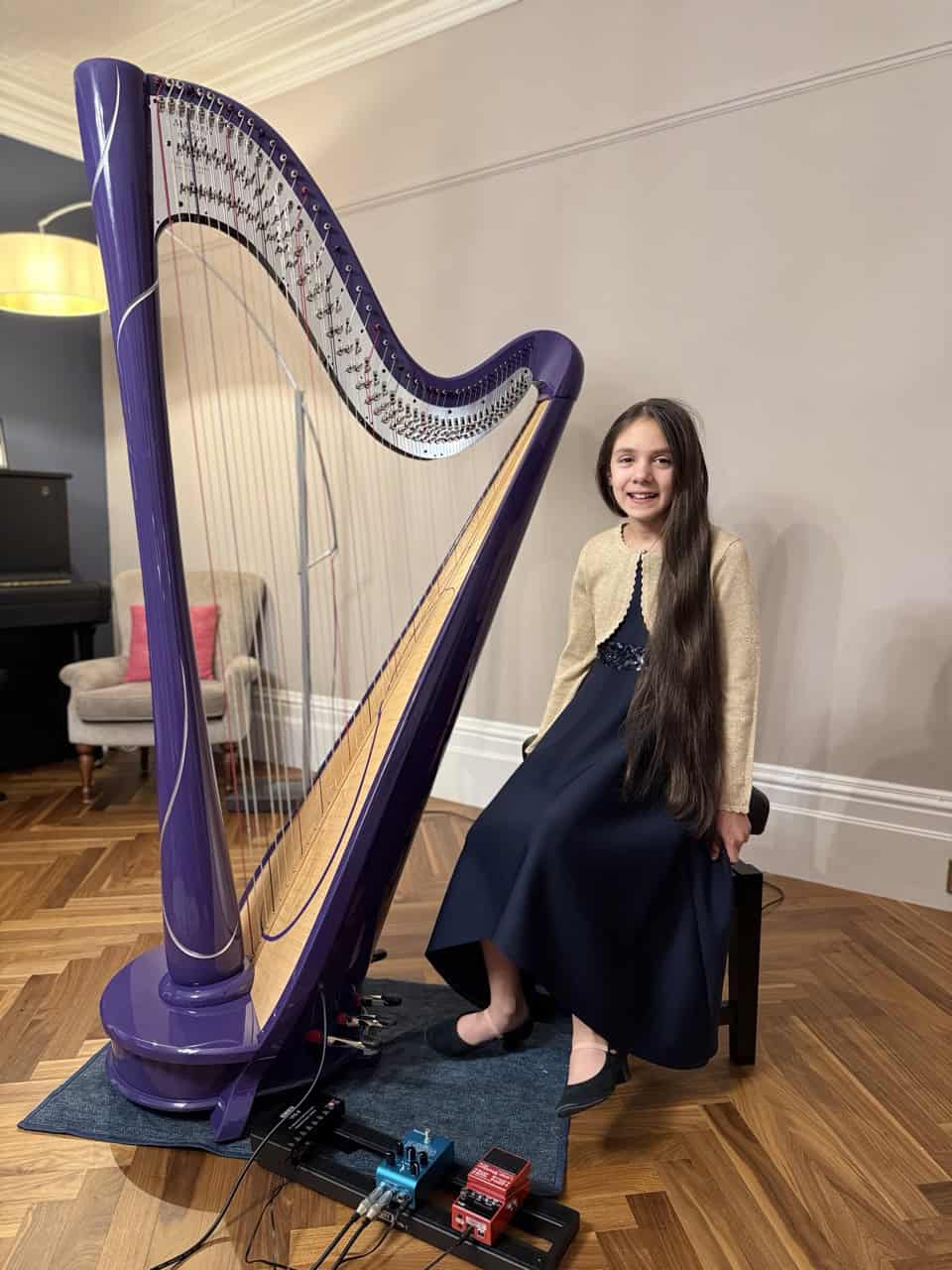
Question: What inspired you to write the Sonando en Espanol concerto?
Hi Deborah, my name is Jemima, I’m 11 years old, I’m a very keen harpist and love your music.
I’m writing a school project about what the greatest piece of music is. I’ve chosen to write about your concerto Soñando en Español and my all time favourite is Baroque Flamenco – which I love to play.
Would you be able to send me a short line about what inspired you to write the concerto? I know about Baroque Flamenco’s link to Rousseau’s Minuet in A minor and want to know your inspiration for writing the concerto in total?
Many thanks,
Jemima
Answer:
Hi Jemima –
Thanks so much for reaching out – I’m honored to be part of your school project. You’ve asked a powerful question, and as it happens, I’m just now creating a whole presentation about this exact question, and how the Rousseau minuet has expanded throughout my life to give me access to new stages, new levels of self-expression and now new friends around the world who are performing and adapting it.
The presentation I’m creating is called “My Life with Jean Jacques Rousseau” and it’s for the upcoming World Harp Congress in Toronto, Canada – and YOU just helped me create it by asking an excellent question. Please also note there’s a question from me to you at the very bottom of this email.
I’m sorry to say (or maybe happy to say) that I can almost never describe anything in one sentence, so here’s the story:
A Late Start to the Harp
I started the harp as an adult, although I’d had a few lessons – maybe 6 or 7 – when I was about your age. I wasn’t interested then, but got interested in college, when my college band needed a harpists and I was the one with the most experience. (Note to other aspiring musicians – even just a few harp lessons as a child can change your life).
Where did they put the Harp’s “Paganini Concerto”??
When I finally got solid enough that I could think about performing, I decided it was time to find that piece for the harp that’s like the Paganini violin concerto #1 is for the violin: virtuosity and fire, combining skill and emotion – and having both drama and charm – a piece that would make the audience jump up and cheer at the end with excitement. I didn’t grow up in the classical world, but I just assumed every instrument had at least one piece like that.
But I couldn’t find ANY! I was shocked – and soon afterwards I wrote my first piece for harp: Nataliana. It wasn’t Paganini – but it was a start.
The Seed: Rousseau’s Minuet
My teacher Linda Wood had given me Samuel Milligan’s ‘Medieval to Modern’ harp book, and I’d fallen in love with a little Minuet in it by Jean Jacques Rousseau and was already improvising on it. I didn’t know it then, but that was the seed of “Baroque Flamenco”, but it wasn’t until many years later that it occurred to me to expand my improvising to explore the idea of contrast that already exists in that piece to far beyond anything Rousseau might have conceived.
It happened slowly over time – and I played many versions of the piece, some with different names.
First Expansion: The Rondo Form
First, I expanded the Minuet into a Rondo, going back and forth between the main melody and what seemed like an ‘improv form’ of the 2nd theme. I used a classical technique called “Augmentation” that I’d learned in music school to change the duration of each improv, and the piece became an improv learning tool for me as well as a piece I loved.
Adding Latin Fire: The Mexican Triple Waltz
Much later – I think, at least 15 years later – one day it occurred to me to increase the contrast between the two themes by keeping the main theme in the Baroque style, but using one of my favorite Latin rhythms (the Mexican Triple Waltz) for the improv theme.
I played it that way for years with my band, then one day we were in a jazz club, on tour in Germany. As we were packing up, over the house system came the music of Ottmar Liebert’s “Nuevo Flamenco.” I was exhausted from the tour and as I heard the Flamenco and looked at the harp, my exhausted brain saw the harp totally differently and I thought, “Why, the harp is just a BIG GUITAR! And the soundboard is a drum! How could I have missed that???”
The Flamenco Revelation
I had just found the element of fire to add to the piece! And now I was desperate to be able to play with the passion and rhythm of Flamenco, so I sat down and crafted the cadenza. That was exciting – but then I had to teach myself to play it.
Coordinating the different techniques was the most difficult part. I had to shout out loud each different technique I was playing in order to develop the coordination, “STRUM! Slap slap! NOTE! STRUM! SLAP!”
A New Year’s Eve Vision
I now had the fire, the passion and the structure, but it wasn’t a concerto yet – because I didn’t know how to write music for orchestra.
Then, one New Year’s Eve, I had a vision: In the vision I was playing with a symphony orchestra, I was wearing my harp and the sound of the harp was soaring over the full orchestra – even louder than the brass section. I realized that this was the piece I’d been looking for decades before, and after that moment, I was committed to learn to orchestrate and to write harp concertos that would have that power and breadth, to play them with symphonies around the world and publish them for other harpists to play.
I was determined that the next time some young harpist thought: “Where’s that piece for harp that lets me shine like the Paganini concerto does for violin” I wanted the piece to be there for her.
A call from the Boston Pops
I knew the first piece I would turn into a concerto would be “Baroque Flamenco.” At first I tried combining my band with a string quartet to fast-track the experience – but that didn’t work.
Then one day, the Boston Pops called me and asked if I’d like to be a featured soloist with them. I said yes … but only if I could write my own pieces. They agreed, I got a book called ‘How to Orchestrate’ and they introduced me to an arranger who could help me – and 8 weeks later, finally I had my concerto – the one I had been looking for decades before.
The Review That Changed Everything
I will never forget the day when I opened up The Boston Globe and I saw a review of the piece. The reviewer described it as “the stirring ‘Baroque Flamenco’” and I knew that the piece worked – not just for me as a player, but for the audience.
From One Movement to Three
After that, for years I played “Baroque Flamenco” as a one-movement concerto in alternative orchestral programming, and in 2005 I recorded a whole album of my orchestra works that got a Grammy Nomination for Best “Classical Crossover” Album. But I wanted the piece to be able to be playable in standard classical orchestral programming as well. For that it needed two more movements. ‘Merceditas’ was from another concerto that had originally been written for two harps (which is why certain parts of it are soooo tricky to play), but it was perfect as the slow, romantic second movement. “My Mother’s Mexican Hat” was from one of my jazz recordings, a piece inspired by Chick Corea’s “Spain” in which I was experimenting with other Flamenco techniques. It was the perfect First Movement, setting up the rhythmic and Flamenco themes.
A Story Emerges
Together, the three movements tell the story of a young girl who falls in love with Mexican rhythms, and then as a young woman with a Mexican poet – and who finally lives a life filled with passionate rhythms, whimsical stories and romance.
And that is the story of Soñando en Español.
I’d love to hear what you love about the piece, and if you have any different feelings about it now that you know the story.
Jemima’s comment about the story:
Hi Deborah,
Thank you so much for your amazing email and for sharing the story behind Soñando en Español. I loved reading it, and it made me enjoy the piece even more.
One of the things I love most about the concerto, and a large piece of my essay, is how the piece challenges what harp music can be, it is so full of colour and energy. It was an introduction to extended harp techniques for me and I love it for this. It feels like the harp is doing things I didn’t even realise were possible. It’s great to hear that this was your intention at the start of the creation of Baroque Flamenco.
Now that I know the story, the piece makes even more sense to me. Knowing how long it took to grow makes it feel more special. I love that it grew from all the experimentation and I think it’s the Latin rhythms and Flamenco elements that drew me to the piece.
Thank you again for taking the time to write to me. It means a lot, and it’s really inspiring.
DEBORAH HENSON-CONANT
Composer · Performer · Harp Mentor
PROJECTS & PERFORMANCES:
FOR HARPISTS:
- Join Hip Harp Academy
- Harp Time Live (FREE Weekly Playalong)
- FREE Resources


Hey Deborah
Glad you published this. It’s always interesting to know how good music was written, especially over time. This is a really intriguing story.
Jemima got more than she could have hoped for, and you’ve given her a real gift. Some day she may talk about your letter as a spark that started a career. She’s obviously a girl with a lot of potential. And at 11, she’s got a lifetime to develop it.
Speaking of time, have you listened to my Stray Muse album, About Time (shameless plug)? Let me know if you ever get a chance to check it out!
– Mark
Do you mean THIS Stray Muse album, Mark: https://www.youtube.com/playlist?list=OLAK5uy_n3i25GhuKpq61BvBt9ieHj2_s4epAc1pA from this band? https://straymuse.band/ (she said, adding linkability to shameless plug)? I did! And I thought I wrote to you about it — and getting me to listen to any recorded music is like pulling teeth.
AND I will say that the title track made me think that IT’S ABOUT TIME to start working on “The Dukorsky Syndrome” again! So the message of the music has already had an impact.