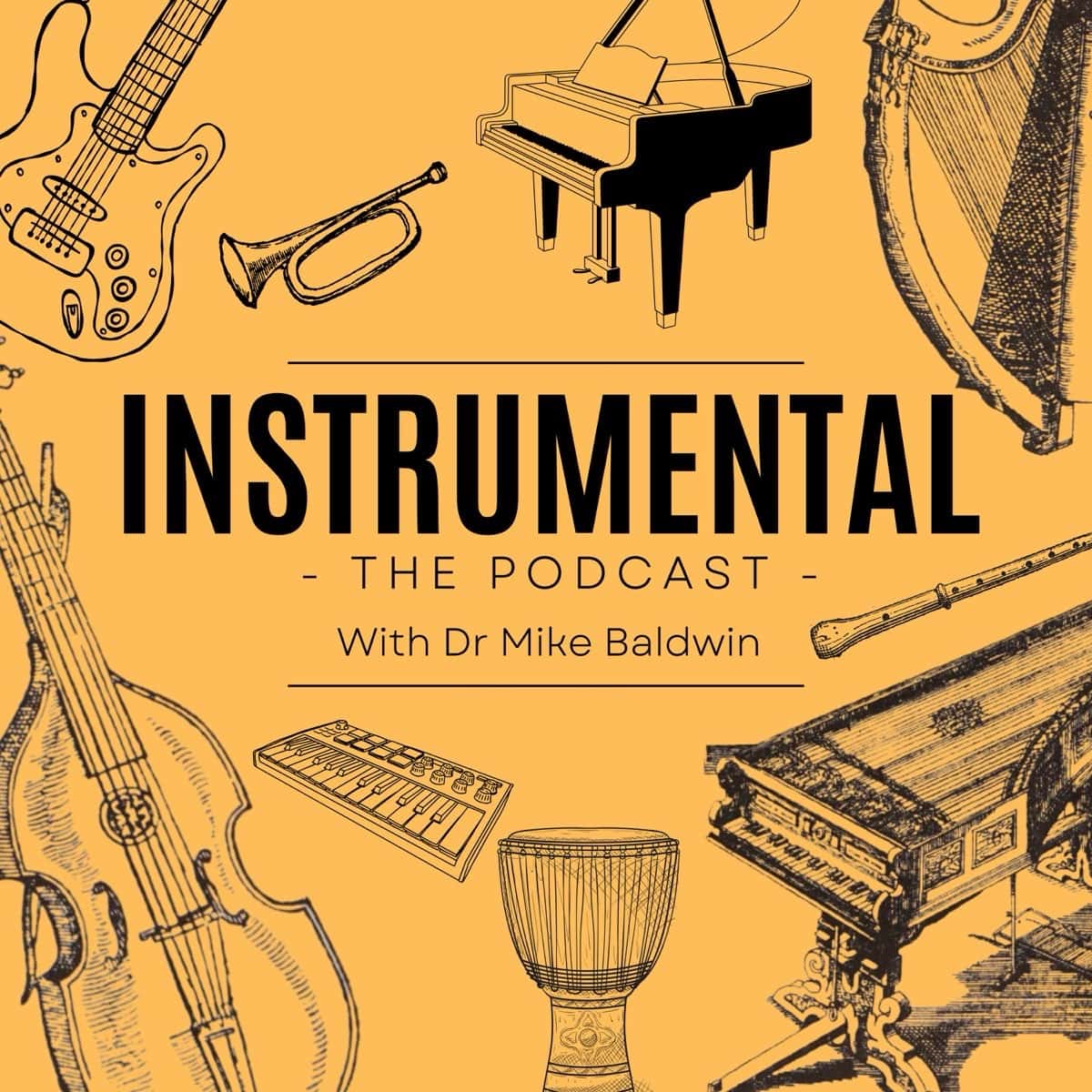
Mike’s podcast, “Instrumental,” explores hidden stories of musical instruments — from ancient bone flutes to modern synthesizers — and how they shape us as humans. So when Mike introduced me as “one of the most influential voices in redefining what the harp can be,” I knew we were about to dive deep into creativity, transformation, and the many lives I’ve lived through the harp.
Discovering the Harp by Accident
Mike began by asking how I started with the harp — and I laughed, because the answer is: accidentally.
I didn’t begin life as a harpist. I began as a kid who wanted to tell stories with music. My parents tried piano, guitar, even a few harp lessons — and I hated lessons. It wasn’t the instruments I resisted, it was the idea that my job was to reproduce notes instead of invent worlds.
Eventually, they gave up and just left me alone with the family piano. I started writing musical theater, despite the fact I couldn’t read or write music, but was utterly devoted to musical storytelling. Years later, while trying to finish my first full-length musical The Golden Cage, I realized I needed to learn notation. I went back to school, and the school needed a harpist. Since I’d had those few lessons as a kid, I suddenly became “the harpist.”
At first, the harp was a day job—a practical way to make a living while I pursued my theatrical composing. I discovered I could:
- Play background music
- Play weddings
- Get hired with very little experience because the instrument itself created an aura of legitimacy
But my theater background followed me into every gig. I didn’t just want to “provide background.” I wanted no dry eye in the house at every wedding. I wanted story, emotion, arc.
And that’s where improvisation—and the person you now know as DHC—really began.
The Waiter Who Changed My Life
That impulse — to make everything expressive — is how improvisation entered my life.
I was playing harp in a restaurant, wearing my long dress, with exactly four songs I could play. After the third repetition, a waiter came over with a pitcher of water and said, “If you play those songs again, I’m pouring this in your lap.”
That moment of panic sparked invention. I took a tiny Rousseau minuet and turned it into something new — improvising sections, stretching phrases, repeating, transforming. It was my first experience of real creation at the harp.
That’s when I realized the harp could be a laboratory — a place to experiment with impulse, structure, and character. It became my space for exploring how story and sound collide.
From a Minuet to Baroque Flamenco
As I told Mike, that little minuet became the seed of my piece Baroque Flamenco. I’d been searching for a harp piece that felt like a Paganini violin concerto — hair flying, passion blazing, everything at stake. One night, exhausted after a jazz club gig, I heard Ottmar Liebert’s Nouveau Flamenco playing and thought, “My god — the harp is a giant guitar!”
That revelation led me to discover the harp’s percussive side. I built the cadenza, choreographed its energy, and even invented the final backward glissando to create that thunderous “BAM” at the end.
People often say I broke the mold — but really, I just never saw it. I didn’t grow up surrounded by harpists or recordings of what “harp music” should be. I simply asked the question: What can this instrument help me express?
Reinventing the Physical Relationship
Mike, being a harp maker himself, seemed fascinated by how physical my relationship to the harp had become. I told him that, at one point, I actually felt trapped behind it — like it was a piece of furniture I was hiding behind.
That’s when I went to study with Tony Montanaro, a mime and physical theater artist. He taught me to see the harp as an object to play with, not just play on. People in his workshops treated the harp like a giant toy — even pretending to ride it like a horse! That one absurd moment opened my eyes: I needed to change my physical relationship to the instrument.
That revelation eventually led to my collaboration with Camac Harps and the creation of the DHC Electric Harp — a wearable, amplified harp that finally let me move freely onstage.
Vulnerability and “The Nightingale”
We also talked about The Nightingale, a quiet piece that taught me one of my hardest lessons: vulnerability.
For years, I refused to perform it because it didn’t feel “impressive” enough. Then a conductor stopped me in rehearsal and said, “Don’t perform this. Play it as if you are a child.” That moment transformed everything. It reminded me that true connection doesn’t come from showing more — it comes from hiding less.
Mike seemed to resonate deeply with that. He said it’s hard to be vulnerable in a world that’s always watching — and even harder when your vulnerability happens on stage. We both agreed: that’s where the real growth happens.
Transformation, Pollination, and the Imago
One of the most beautiful turns our conversation took was when we began talking about metamorphosis — how creativity changes form. Mike mentioned the philosopher Bernard Stiegler’s idea of “general organology” — how tools, bodies, and culture evolve together.
It seemed to resonate with my own fascination with the butterfly’s transformation — caterpillar, chrysalis, butterfly — and the imago, the final stage that becomes a pollinator. That’s how I see this phase of my life now: performer, composer, teacher. Three parts that are modular, synergistic, and all feeding each other.
My role has shifted from creating to pollinating — helping other musicians discover their own voice through the harp.
The Harp, Gender, and Liberation
Of course, no conversation about the harp is complete without talking about its image — that delicate, feminine, angelic stereotype. I told Mike that, for me, freeing the harp from that image was really about freeing myself.
Jazz harpist Corky Hale once told me, “When you walk on stage, look the way you’re going to play.” So I did. I showed up in my own way — short skirt, wild hair, electric harp — and something clicked. I realized the harp could embody strength, boldness, and fire, just as much as grace and beauty.
What Stayed With Me
By the end of our talk, Mike said, “If I were to sum you up in one word, it would be vitality.”
That word stuck with me. Because what we shared wasn’t just a conversation about the harp — it was about aliveness. About how instruments aren’t just tools; they’re mirrors. They show us who we are becoming.
The harp, for me, isn’t a destination. It’s a vehicle — for stories, identity, metamorphosis — and for connection.
It occurred to me that perhaps that’s what “Instrumental” is about too: discovering how the things we create end up creating us. But you’ll have to listen to more of Mike’s podcasts to get the full story on that. I know I’ll be listening!
You can hear my full conversation with Mike Baldwin on the Instrumental podcast on Spotify
Get updates for my next shows, concerts, and other appearances on my Events Page
DEBORAH HENSON-CONANT
Composer · Performer · Harp Mentor
PROJECTS & PERFORMANCES:
FOR HARPISTS:
- Join Hip Harp Academy
- Harp Time Live (FREE Weekly Playalong)
- FREE Resources

Join for Freebies, Stories & News
Join to get weekly-ish emails with stories, videos & events like concerts & classes
Yay! You should get my next newsletter within the next 7-10 days. I'm so happy we'll be in touch!
I won't ever share your email address with others - and you can unsubscribe anytime, tho most people say they really enjoy these weeklish emails.